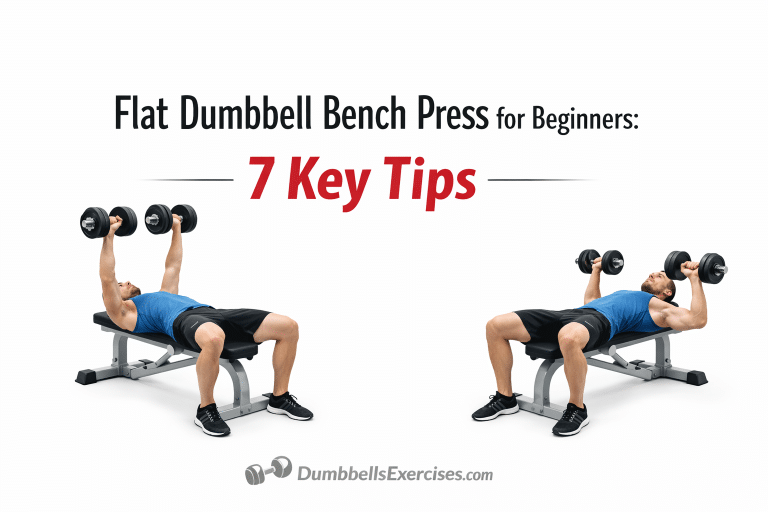
The flat dumbbell bench press for beginners is one of the most effective movements for developing chest strength and overall upper-body power. Compared to barbell pressing, dumbbells provide a more beginner-friendly experience by allowing natural movement patterns and improved muscle balance. This guide breaks down 7 essential tips to help you master the flat dumbbell bench press safely and effectively, setting the stage for long-term progress.
If you’re new to strength training or transitioning into free weights, proper technique is critical. While the flat dumbbell bench press for beginners requires attention to detail, learning it correctly will quickly build confidence, strength, and control.
Why the Flat Dumbbell Bench Press for Beginners Is an Ideal Starting Exercise
The flat dumbbell bench press for beginners offers several advantages over barbell pressing, especially for those new to resistance training. Because each arm moves independently, dumbbells help expose and correct strength imbalances early. This independence also supports healthier shoulder mechanics and reduces injury risk.
Research from the National Strength and Conditioning Association shows that dumbbell exercises engage stabilizer muscles more effectively than barbell movements. For beginners, this means building a stronger, more balanced foundation that translates well to other lifts. The natural arc of motion allowed by dumbbells is also easier on the joints and feels more intuitive for most lifters.
Another major benefit of the flat dumbbell bench press for beginners is safety. When training alone, dumbbells can simply be dropped to the sides if failure occurs—unlike a barbell, which can trap you. This added security often allows beginners to train with more confidence and focus.
Tip 1: Dial In Your Bench Setup and Body Position
Proper setup is the foundation of a successful flat dumbbell bench press for beginners. Before lifting the weights, your positioning should feel stable, controlled, and repeatable.
The Five-Point Contact System
Maintain these five points of contact throughout every rep:
- Head: Flat on the bench, eyes looking slightly forward
- Upper back: Shoulder blades pulled back and down for stability
- Lower back: Maintain a natural arch—neither exaggerated nor flat
- Glutes: Firmly pressed into the bench
- Feet: Flat on the floor to provide balance and leg drive
This setup creates a strong base and improves force transfer. Think of “packing” your shoulders by gently squeezing your shoulder blades together, as if holding a pencil between them. This protects your shoulders and enhances chest activation.
Optimal Foot Placement
Position your feet roughly shoulder-width apart, flat on the floor, and either directly under or slightly behind your knees. Proper foot placement enhances total-body stability during the flat dumbbell bench press for beginners.
Tip 2: Use the Correct Elbow Angle and Arm Path
Elbow positioning is one of the most important technical details in the flat dumbbell bench press for beginners.
Avoid flaring your elbows straight out to the sides at 90 degrees. Instead, aim for about 45 degrees from your torso. This “arrow” position reduces shoulder strain while still targeting the chest effectively. As you lower the dumbbells, think about gently tucking your elbows toward your ribs.
The dumbbells should move in a slight arc rather than straight up and down. At the top, they should align over your shoulders or upper chest—not your face or stomach. This natural movement path is one of the biggest advantages of dumbbells over barbells.
Tip 3: Get the Dumbbells Into Position Safely
Many beginners overlook how to safely start the flat dumbbell bench press, especially as weights increase.
The Knee-Up Method
Follow this step-by-step approach:
- Sit on the bench with dumbbells resting upright on your thighs
- Grip the weights securely
- Lean back while lifting your knees
- Use your legs to guide the dumbbells to shoulder level
- Press them up into the starting position
This method minimizes strain on your shoulders and lower back. Trying to lift heavy dumbbells directly from the floor while lying down is inefficient and risky.
Tip 4: Execute Each Rep With Controlled Technique
Once positioned correctly, execution becomes the focus. According to ACE Fitness, proper control in both phases of the lift is essential.
Lowering Phase (Eccentric)
Lower the dumbbells over 2–3 seconds until they reach chest level or slightly below. You should feel a stretch in your chest muscles but no shoulder discomfort. The dumbbells should align around nipple height—not too high or too low.
Pressing Phase (Concentric)
Press the dumbbells upward in 1–2 seconds. At the top, bring them close together without touching. Fully extend your arms while keeping a slight bend in the elbows to maintain muscle tension.
Breathing Technique
Inhale deeply before lowering the weights, hold the breath during the descent, and exhale forcefully as you press upward. This breathing strategy increases stability and power during the flat dumbbell bench press for beginners.
Tip 5: Start With the Right Weight
Choosing appropriate resistance is critical for beginners. Too heavy, and form suffers. Too light, and progress stalls.
Most beginners should start with 10–15 lb dumbbells. Some may need lighter weights, and that’s perfectly fine. The goal is controlled, high-quality reps—not ego lifting.
Prioritize Form First
You should be able to complete 10–12 clean reps, with the last few feeling challenging. If form breaks down before rep 8, reduce the weight. If you can exceed 15 reps comfortably, increase resistance gradually—ideally in 2.5–5 lb increments.
Tip 6: Follow a Smart Progression Plan
Progression is essential for long-term results with the flat dumbbell bench press for beginners.
Weeks 1–4: Technique Phase
- 3 sets of 10–12 reps
- 2 sessions per week
- Focus entirely on form
- Use the same weight unless it becomes clearly easy
This phase allows your nervous system to learn the movement pattern efficiently.
Weeks 5–12: Strength Development
Gradually increase weight every 2–3 weeks, as long as all reps are completed with good form and 1–2 reps remain in reserve. Maintain 3 sets of 8–12 reps.
Beyond 3 Months
Once comfortable, you can add variations (incline, decline) or incorporate barbell bench pressing while maintaining dumbbell work as a foundation.
Tip 7: Track Progress and Train Consistently
Logging your workouts is one of the most effective habits for beginners. Record weight used, reps completed, and how each session felt. This data helps guide intelligent progression.
Consistency matters more than perfection. Training the flat dumbbell bench press for beginners 2–3 times per week with adequate recovery will outperform sporadic training every time.
Common Mistakes to Avoid
- Bouncing the dumbbells off your chest
- Lifting hips off the bench
- Rushing repetitions
- Neglecting the lowering phase
- Flaring elbows too wide
Each of these reduces effectiveness and increases injury risk.
Additional Tips for Better Results
- Warm up with light cardio and shoulder mobility
- Focus on feeling your chest muscles work
- Balance pressing with pulling exercises
- Prioritize sleep and adequate protein intake
- Film your sets to assess technique
- Consider professional coaching if available
When to Progress Beyond Beginner Programming
You’re ready to advance when you demonstrate:
- Consistent, flawless form
- Significant strength improvement
- Reduced fatigue from standard routines
- Desire for variety without sacrificing technique
Even at advanced levels, the fundamentals of the flat dumbbell bench press for beginners remain essential.
Conclusion
Learning the flat dumbbell bench press for beginners is about more than lifting weight—it’s about mastering a movement. By focusing on proper setup, safe execution, smart progression, and consistency, you’ll develop chest strength that carries over into all areas of training.
Take your time, respect the process, and prioritize technique over ego. With patience and effort, the flat dumbbell bench press for beginners can become one of the most valuable tools in your strength-training journey.
Every rep matters—make each one count. 💪
Mastering this exercise lays a strong foundation for long-term success in strength training.
References
- American Council on Exercise (ACE) – Dumbbell Bench Press Exercise Guide
https://www.acefitness.org/education-and-resources/lifestyle/exercise-library/41/dumbbell-bench-press/ - Mayo Clinic – Strength Training: Get Stronger, Leaner, Healthier
https://www.mayoclinic.org/healthy-lifestyle/fitness/in-depth/strength-training/art-20046670